Below are 7 cities in the world to be left to die because of natural disasters or wars, and now the artistic creations in the world.
1.Sanz Hill
North adjacent to Taiwan, there is a village that is futuristic, was originally built as a luxury retreat for the rich. However, after a lot of fatal accidents during its construction project finally stopped. After experiencing difficulties in funding and the difficulties of the workers who would work on the project eventually resort development is completely stopped in the street. Rumours then appeared, many say the area has become home village of ghosts, from those who have died.
2. Craco
Craco situated and the province of Matera Basilicata region about 25 miles from the Gulf of Taranto. This mid-city area with a typical has fulfilled the undulating hills and the expanse of wheat farming and other agricultural crops. Craco 1060 when ownership of land is owned by the bishop of the diocese leader Arnaldo Tricarico. Longstanding relationship with the church brought a lot of influence to the whole population. In 1891, Craco population of more than 2000 people, then they hit a lot of social problems and poverty that many of them desperate, between the years 1892 and 1922 about 1,300 people moved into North America. Poor agricultural conditions coupled with natural disasters earthquakes, landslides, and war is what caused them to migrate en masse.
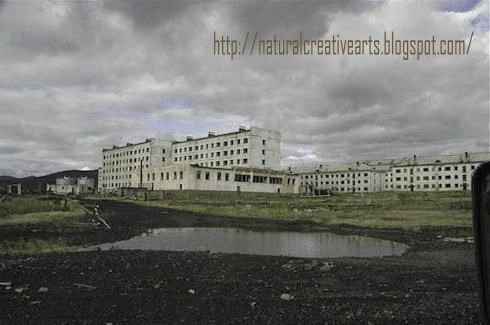
3.Kadykchan
Kadykchan is one small town in Russia which was destroyed during the collapse of the Soviet Union. Residents are forced to struggle to gain access to water, health services and schools. They should get out of the city within 2 weeks, to occupy other cities and occupy a new home. Cities with population of about 12,000 people on average as a tin miner is emptied. They left their home with all its furnishings. So you can find toys, books, clothing and various items in an empty city.
4. Agdam
Agdam big city in Azerbaijan is one of the big cities where the population of 150,000. But then disappearedafter the war in 1993 over Nagorno Karabakh. Although the city is not directly the basis of warfare, but thistown still get the effects of the war, by becoming a victim of the attitude of the Armenians who destroy the city. The buildings destroyed and finally abandoned, leaving only the mosques are still standing intact. Agdampopulation itself had been moved to other areas, such as into Iran .
5. Prypiat
Prypiat is a major city in isolated areas in northern Ukraine, an area housing the workers of Chernobyl nuclear region. This area is dead since the Chernobyl nuclear disaster that claimed nearly 50,000 lives. After the incident, the site was practically like a museum, became part of Soviet history. Apartment buildings, swimming pools, hospitals, and many other buildings were destroyed. And all of the information contained in such buildings left in it, such as archives, TV, toys, valuables, clothing, etc. all like most of the families in general.
6. Oradour Sul Glane
Small settlements Sul Glane Oradour in France showed a very terrible state conditions. During World War II, 642 residents were massacred by German soldiers as a form of retaliation for the French against the treatment time. Germany who was actually intended to attack the region near Sul Glane Oradour but eventually they attacked the small settlement on June 10, 1944. according to the testimony of those who survived, the population of men put into a warehouse and German soldiers opened fire on their feet so that eventually they die slowly. Women and children who entered into the church. eventually all the dead were shot when they tried to get out of the church. The village was completely destroyed the German army at that time. And to this day the ruins of the village is still standing and bears witness to just how cruel events that occurred at that time.
7. Varosha
Varosha is an area that is not recognized by the republic of North Cyprus. Before the 1974 Turkish invasion of Cyprus, this area is a modern tourist area in the city of Famagusta. In the past three decades, the city is abandoned and becoming a ghost town. In the 1970s, the city has become a major tourist destination in Cyprus. To provide a satisfactory service to the tourists, the city has built many luxury buildings and hotels. When the Turks controlled the region, they maintain and defend the area, there should be no out into the city without permission from the Turkish army and UN troops. Plans to restore Varosha back into the hands of Greek control, but the plan never materialized. Nearly 34 years of the city is left and no improvement. Slowly these buildings were destroyed, the metal started to rust, jedela broken, and the roots of plants penetrate walls and sidewalks. Turtle nesting in the abandoned beach. In 2010 the Turkish government intends to reopen Varosha to the tourists and the city can be inhabited again and will be one of the most influential cities in uatara island.
Sunday, December 26, 2010
Root Bridge in West Sumatra, Indonesia
This is now a tourist attraction mainstay of South Coastal District which is one of the most unique bridges in dunia.jembatan strong and be a liaison between the two regions Jorong (Hamlet) Puluik Puluik and Lubuak-Glare, Glare Lubuak Village, District of North Bayang, South Coastal District, West Sumatra.
From the information that was summarized one community leader and chairman of the youth-puluik Pulik, Herman Datuak Rajo Bandaro, the bridge was made by a scholar named Pakih Sokan pity to see the students mengajinya of Pulik-puluik often do not come due to stem the flow of shadows often overflowed
In 1916 Pakih Pohan planted two sticks ox-ox (a type of broad-leaf banyan tree), tree-ox ox was planted in two locations-one in the area Pulik puluik and one in the area Lubuak Glare separated by a shadow bar. Then the roots are hanging woven on a bamboo rod made of bone bridge as the root bridge. After 3 years the roots of two trees ox-ox are linked but not impassable.
Label:
bamboo art,
beauty world art,
root art,
wood art
Bridge vines in Iya Valley, Japan
One of the three valleys of "hidden", in Japan, West Iya is the place foggy canyon, the river clean, and the roofs of straw or leaves, such as describing the Japanese centuries ago. To cross the river that flows along the Iya valley slopes, the robbers, the kstria, and refugees make a special bridge made of vines.
Below is a picture of a bridge of vines in 1880 :First, the two plants Wisteria - one of the most robust vines - planted to extremely long from both sides of river. When the plant reaches a sufficient length, then woven together with the board to make a living botanical engineering, soft but very sturdy.
Bridges that have no sides, and a source of Japanese history shows that the bridge is unstable plants, and who tried to cross it the first time are often frozen in place, unable to proceed further.
Three of the bridges that still exist in the valley Yes. Although some (not all) of the bridges were reinforced with wire and strip the sides, it is still scary to cross. More than 42 meters in length, with a board that is placed every 6 to 8 inches, and the fact that one fell into the water from 4.5 story, make it unsuitable for people with acrophobia (fear of heights).
Some people believe the bridges that still exist vines was first built in the 12th century, which makes some of the examples in the world's oldest living architecture.
First, the two plants Wisteria - one of the most robust vines - planted to extremely long from both sides of river. When the plant reaches a sufficient length, then woven together with the board to make a living botanical engineering, soft but very sturdy.
Bridges that have no sides, and a source of Japanese history shows that the bridge is unstable plants, and who tried to cross it the first time are often frozen in place, unable to proceed further.
Three of the bridges that still exist in the valley Yes. Although some (not all) of the bridges were reinforced with wire and strip the sides, it is still scary to cross. More than 42 meters in length, with a board that is placed every 6 to 8 inches, and the fact that one fell into the water from 4.5 story, make it unsuitable for people with acrophobia (fear of heights).
Some people believe the bridges that still exist vines was first built in the 12th century, which makes some of the examples in the world's oldest living architecture.
Label:
bamboo art,
beauty world art,
root art,
wood art
Subscribe to:
Posts (Atom)